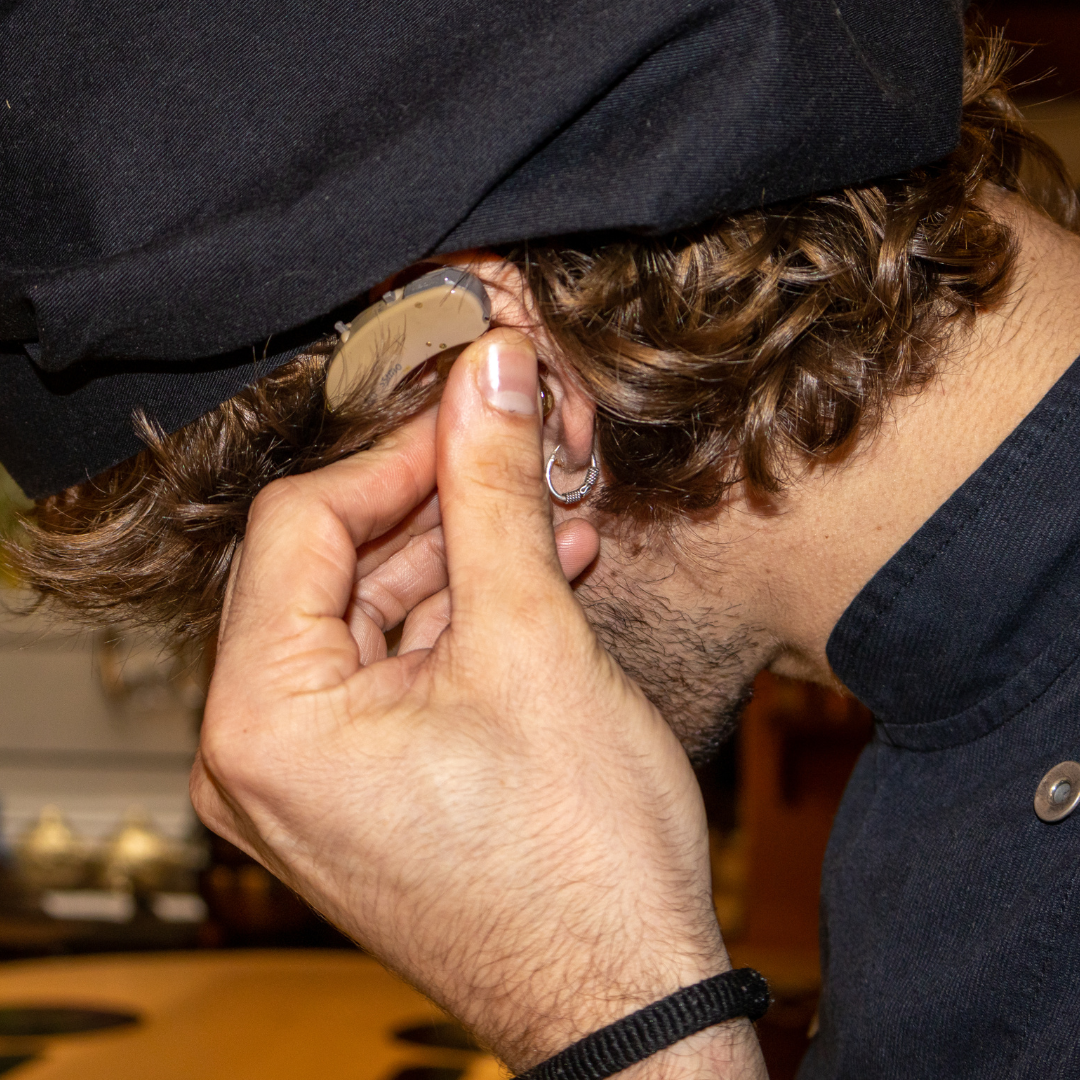
Restaurant conversations can be difficult to follow when environmental noise competes with your focus and hearing. Our clinical team can evaluate hearing across quiet settings and background-noise environments to pinpoint specific auditory challenges. After uncovering the precise factors driving your difficult hearing, our team helps you select individualized auditory solutions.
Understanding the Contrast Between Quiet Hearing and Restaurant Noise
Low-noise environments yield an advantageous signal-to-noise ratio where primary speech remains significantly louder than background sound. Dining rooms present an unfavorable acoustic reversal of this dynamic. Cross-talk, ambient music, dishware noise, and harsh acoustic reverberation interfere with speech clarity, forcing your brain to labor to extract the target voice.
These auditory struggles commonly accompany untreated high-frequency hearing loss, central processing delays, or presbycusis. Factors including listening fatigue, poor dining lighting, acoustic distance, and wandering attention make comprehension significantly harder. Certain patients demonstrate normal sensitivity on routine audiograms while struggling significantly during advanced speech-in-noise testing. Experiencing speech-recognition struggles in noisy dining venues warrants a formal audiological evaluation regardless of seemingly normal quiet hearing.
Clinical Evaluation of High-Frequency Hearing Loss
We begin by reviewing your history of communication difficulties, prior noise exposures, ringing or tinnitus, pharmaceuticals, and unilateral symptoms.
Diagnostic pure-tone audiometry establishes the softest auditory thresholds you can perceive across standardized frequencies via air and bone conduction pathways. High-frequency hearing loss commonly presents on the audiogram as a characteristic precipitous drop in the higher frequency ranges. Comprehensive evaluations frequently include impedance tympanometry to examine middle-ear function and recorded word-recognition testing to measure speech understanding.
A quiet sound booth cannot replicate complex dining room acoustics, which makes clinical speech-in-noise testing especially informative. This procedure gauges speech-discrimination accuracy while competing multi-source noise becomes incrementally louder. In combination, these diagnostic metrics reveal whether communication hurdles involve audibility thresholds, speech discrimination, neural noise management, or mixed conditions.
The Role of Central Auditory Processing Disorders in Adults
An auditory processing disorder compromises how the central auditory pathways and brain decode incoming acoustic information. Even when the ears detect individual frequencies accurately, the central auditory system may falter at sorting overlapping voices, distinguishing close speech sounds, or processing fast-paced dialogue. We systematically verify peripheral hearing health before establishing whether an advanced auditory-processing evaluation or medical referral serves your needs.
Actionable Listening Tips for Noisy Social Settings
Small, intentional adaptations can optimize the clarity of speech reaching your ears and leverage helpful visual speech cues. Before dining out, choose a quieter restaurant or visit during an off-peak time. Facilities equipped with upholstered booths, acoustic baffles, fabric curtains, carpeted floors, and soft materials prove far easier on hearing than minimalist, hard-tiled spaces.
Upon entering the restaurant:
- Ask host staff for a quiet table distanced from kitchen traffic, bar noise, audio speakers, and loud group tables.
- Choose a seat with your back against a solid wall to block acoustic clutter originating from behind.
- Seat yourself facing conversation partners under clear, bright lighting to facilitate visual speechreading.
- Sit as close to the speaker as comfort permits to preserve speech volume and clarity.
- Orient your stronger ear toward the key person you want to follow in conversation.
- Instruct conversational partners to reword missed phrases instead of repeating the entire sentence verbatim.
- Explicitly repeat back important logistical details instead of pretending you caught every word.
- Take a brief listening break when fatigue begins to build.
- Request that dining partners articulate words distinctly at an unhurried, natural speed.
- Yelling distorts natural speech formants and rarely makes spoken words easier to decipher.
What Are the Best Tools for Hearing with Background Noise?
Selecting the ideal assistive technology depends upon underlying diagnosis, specific acoustic challenges, and verified hearing loss. Customized hearing aids employ directional microphone beamforming, noise cancellation algorithms, and targeted dining programs to prioritize speakers in front while lowering ambient noise. Realistic expectations are vital, since even advanced hearing devices cannot completely erase background conversational chatter.
Incorporating a dedicated remote microphone provides an even more pronounced improvement in signal-to-noise ratio. The accessory is worn on the lapel or set near the speaker, streaming their voice directly into compatible hearing aids or wireless audio receivers. This reduces the effects of distance and surrounding noise.
Further practical hearing technology options include:
- Multi-directional table microphones designed for small dinner gatherings
- Telecoil sensors configured to access hearing-loop broadcasts in looped facilities
- Smartphone speech-to-text or live-captioning applications
- Earbuds or hearables with compatible assistive-listening features
- Acoustic sound-meter apps and dining review directories that score restaurant noise
We can compare options, confirm compatibility, and teach you how to use the selected device.
How an Audiologist or Physician Can Improve Hearing in Noise
Clinical hearing evaluations progress the diagnostic process past the typical assertion that hearing is adequate in quiet. We analyze the exact social venues, voice registers, and noise environments that cause difficulty to administer tests matching your lifestyle. Your diagnostic appointment may incorporate pure-tone air and bone thresholds, acoustic middle-ear testing, word-recognition scores, and speech-in-noise measures. Central auditory-processing testing is considered whenever clinical intake and initial test outcomes point toward higher-order deficits.
Abrupt auditory reductions, unilateral hearing shifts, or rapid functional deterioration require prompt assessment by an ear, nose, and throat physician. Personalized care identifies the source of the difficulty rather than assuming restaurant noise is the only problem.
Arrange a Hearing Evaluation With Us Now
When dining out causes you to guess at words, detach from family, or experience severe listening exhaustion, book a comprehensive hearing evaluation with us. We provide proven treatments to enhance your hearing in noisy environments, offering hearing aid fine-tuning, specialized assistive accessories, and individualized auditory therapy.
Get in touch with our team to request an appointment and rediscover confident, stress-free restaurant conversations.

